
 English

Corporate Expansion & Manufacturing Excellence | Published by Xiamen Meishang Laboratories Co., Ltd.
You pick at the pimple. You buy a stronger cleanser. You try another "miracle" serum. And two weeks later, the same spots are back — sometimes more of them.
If that cycle sounds familiar, the problem is probably not that your products are weak. It's that your routine is attacking the symptom at one moment and ignoring it at the next. Breakouts return because the three places where they actually start — the daily cleanse, the body skin most people forget, and the periodic deep clean — are being handled randomly instead of as a system.
Here's how those three points work, and how to set them up properly.
First, Understand What a Breakout Actually Is
A pimple is not dirt. This is the single most important idea in acne care, because "washing it out" is what most failed routines are based on.
A break forms when three things align in one pore:
- Excess sebum — the skin's oil production outpaces what the surface can absorb
- Keratin buildup — dead skin cells glue to the pore wall instead of shedding normally
- Bacteria feeding on both — Cutibacterium acnes, the bacteria that lives on everyone's skin, multiplies in that sealed, oily pocket and triggers inflammation
The visible pimple is the final stage. By the time you can see it, the process has been running for days underneath. This is why "emergency" spot treatments only ever handle the tip of the problem — and why a routine that prevents the clog in the first place beats one that fights it after the fact.
Step 1: The Daily Cleanse Should Be Your Strongest, Quietest Step
Most people do this backwards. They reach for the most aggressive cleanser they can find — because acne feels like it needs punishment — and over-strip their skin every morning and evening. Over-stripping sounds good until you realize what it does: stressed skin barrier → more oil production as a compensation → more congestion. The harsh cleanser quietly re-creates the conditions it was supposed to fix.
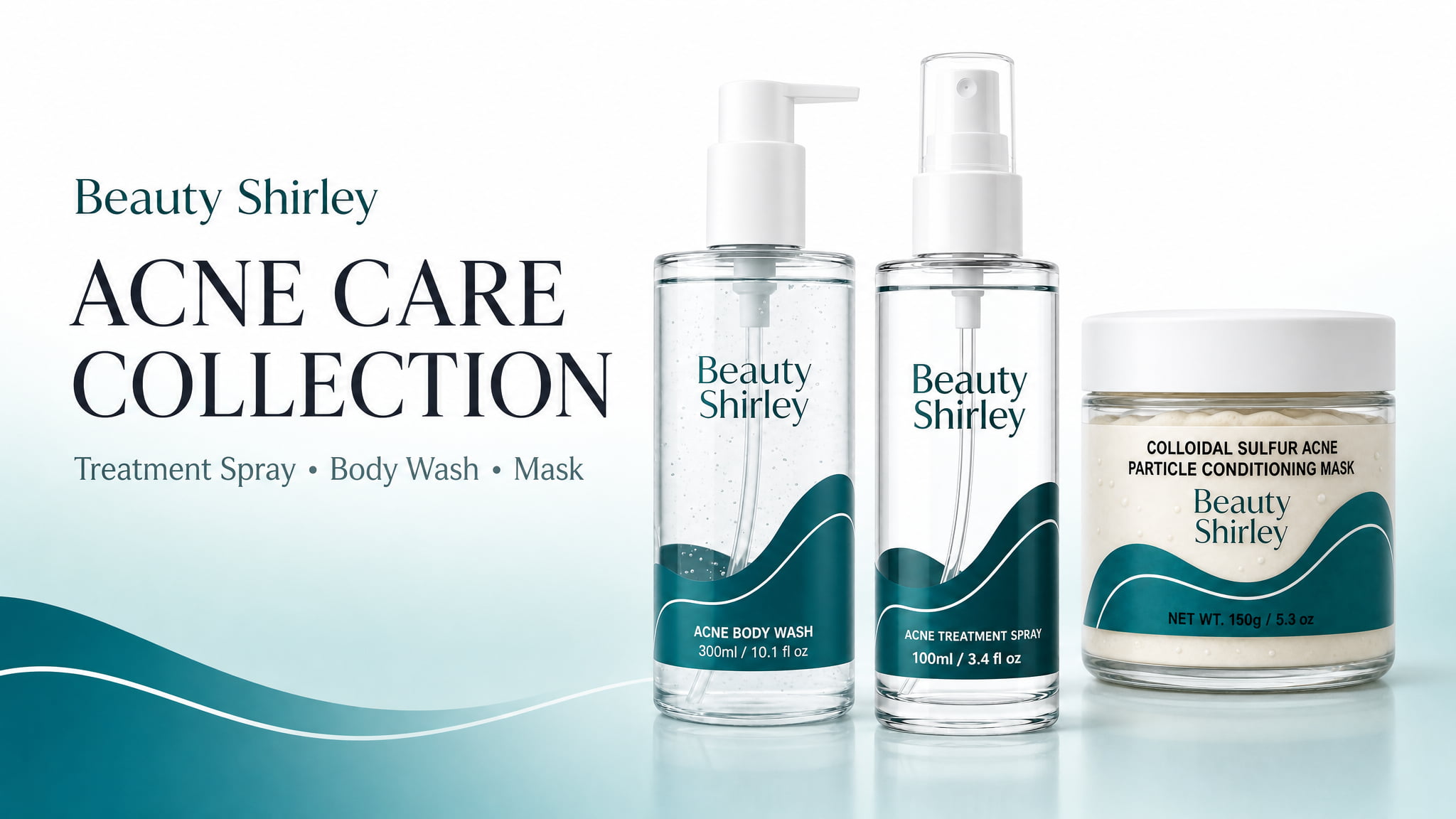
The daily step you want is one that cleans thoroughly at a pH close to skin's natural balance and leaves the barrier intact. That's the job of a colloidal sulfur amino acid foam cleanser — the amino acid surfactant base handles the everyday sebum and residue gently, while colloidal sulfur adds the purifying dimension that a plain hydrating cleanser doesn't have. The tell that you've chosen correctly is simple: your skin should feel clean, not squeaky.
What to look for in any daily blemish cleanser:
- A mild surfactant system (amino acid based, or gentle sulfates)
- One functional active, not ten — the active is there to support, not to assault
- No high-concentration fragrance on reactive skin
- A finish that isn't tight after rinsing
Step 2: Your Back and Chest Are a Separate Problem — and Most Routines Ignore Them
Here's the part most acne advice never mentions: breakouts on the back, chest, and shoulders are the most common acne problem in adults — more common than facial acne in many surveys, and almost never addressed, because facial routines physically don't reach the body.
Body skin is thicker than facial skin and produces a different sebum profile, which is why facial actives often underperform on the back. What body breakouts need is a rinse-off wash with a pore-soluble active that works during the daily shower. Salicylic acid (BHA) is the workhorse here — it's lipid-soluble, so it penetrates the thicker body skin and helps clear the keratin-sebum clog from inside the follicle while you're rinsing.
That's exactly the logic behind a salicylic acid acne body wash: you're not adding a new step to your day. You're simply swapping your ordinary body wash for one that works on the congestion while the shower water is already running.
Body breakouts to watch for:
- Small, uniform bumps across the upper back
- Clogged-feeling pores on the chest
- Recurring flare-ups after heavy sweating or occlusive clothing
Step 3: Once a Week, Give the Pores a Deeper Reset
Daily cleansers work on the surface. There's a layer of sebum and keratin that sits deeper in the follicle, and it needs contact time that a 60-second rinse-off can't provide. That's the slot a weekly mask exists to fill.
For blemish-prone skin, the two ingredients with the longest track record here are clays and sulfur. Bentonite clay has a high adsorption capacity that pulls excess oil out of congested zones; kaolin is gentler and keeps the blend comfortable; sulfur brings the purifying profile. A sulfur particle conditioning mask used one to two times per week sits between the daily cleanser and the spot treatment — deep enough to matter, gentle enough to stay in the routine long-term.
Mask discipline matters more than mask strength:
- One to two times per week is the ceiling for most skin types — more doesn't work better, it just irritates
- Don't let a clay mask fully dry and crack on your face; the "drier the better" belief is old advice
- Follow with a light moisturizer; the barrier still needs support after a deep clean
The Routine, in One Line
Cleanse the face gently every day. Wash the body with a BHA where breakouts actually happen. Reset the pores once a week. Consistency for eight weeks — that's the entire system.